Podcast: Play in new window
Subscribe: Apple Podcasts | RSS | More
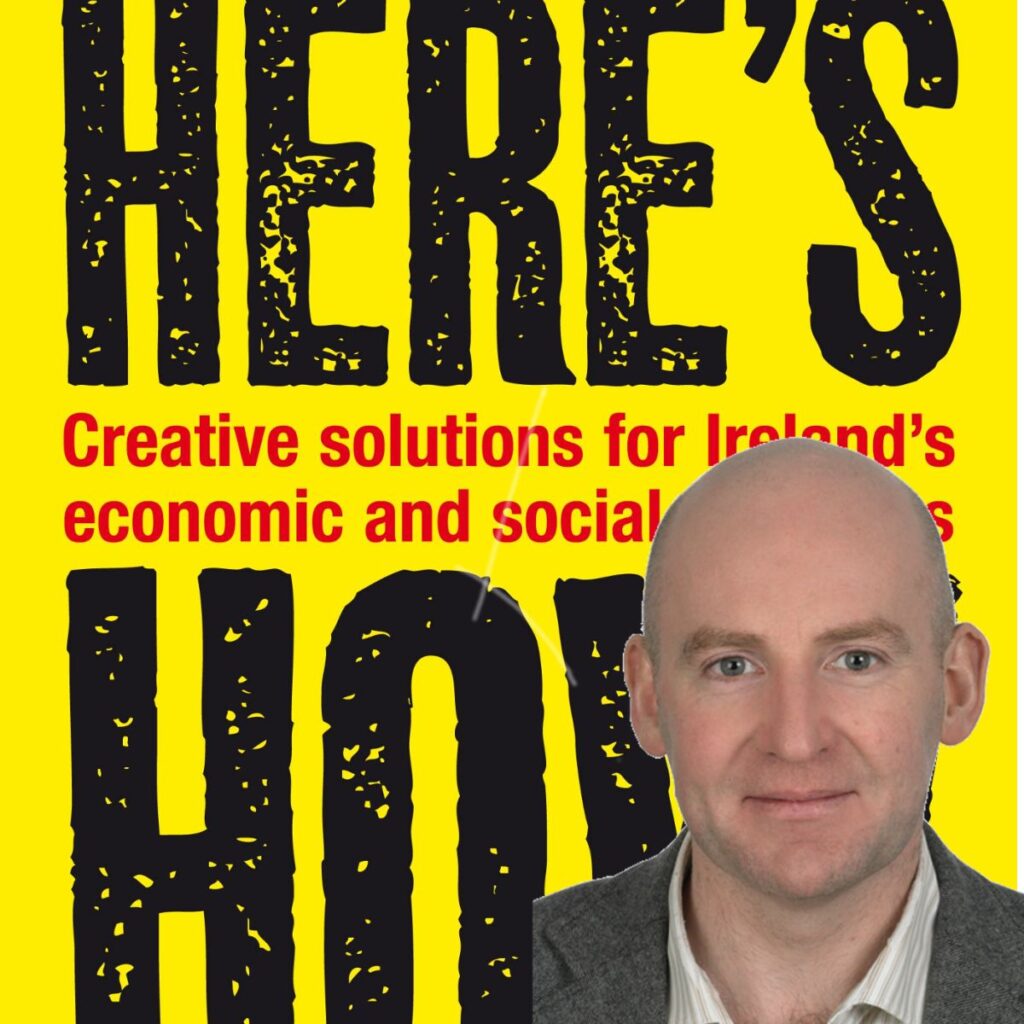
John Moran is the first directly elected Mayor of Limerick.

Podcast: Play in new window
Subscribe: Apple Podcasts | RSS | More
John Moran is the first directly elected Mayor of Limerick.

Podcast: Play in new window
Subscribe: Apple Podcasts | RSS | More
Iain Dale is a presenter on the British talk radio station LBC, former Conservative party electoral candidate and author of the book The Taoiseach: A Century of Political Leadership
*****
Podcast: Play in new window
Subscribe: Apple Podcasts | RSS | More
Frank Connolly is a journalist, author and former head of communications with SIPTU. Tony Lowes is director of Friends of the Irish Environment. Michael Smith is the editor of Village Magazine.
*****

Lucid Talk is the Belfast-based polling company which, every year, does a poll on attitudes in the north to a border poll. Polls are, of course, only polls, but these are useful, because year after year, they do the same poll, with the same questions, the same methodology, so even if you quibble about the results, you can’t argue with the direction of change over time.
In their 2024 poll, unionism had a 10 point lead over nationalism – 49 to 39 per cent. The same poll this year cut that margin to seven per cent. This, of course, isn’t a normal poll, just like anything in Northern Ireland is a normal anything. This is not measuring opinion going back and forth in cycles, this is mostly just reflecting demographic changes. In 2025, that lead is down to seven per cent, 48 to 41 per cent.
At a three-percent-per-year shift, that would point to a nationalist majority before Catherine Connolly is half-way through her first term as president. And that’s not even the real demographic nightmare for unionists. The real disaster is that their support is concentrated in the older demographics. Unionism is, literally, dying.
~ read more ~Podcast: Play in new window
Subscribe: Apple Podcasts | RSS | More
Kev Collins’ Youtube channel his here. Ben Scallan writes for Gript.
*****
That’s a clip I played on the podcast a while back, it’s from one of the far-right protest a while back, and we’ve had a couple more of those anti-immigration protests in the last while. I saw some comments on social media about those protests, one in particular that caught my eye with, some let’s say unflattering photos of a group of protesters, and the comment was ‘Not one junior cert between the lot of them‘.
I’m certainly not going to argue that that woman in the clip or any of her cohort will be winning any Nobel prizes, but I don’t think that it’s constructive to call them stupid. It might cheer the troops, but it’s unhelpful for two reasons. First, it doesn’t win any converts. That is a debate well worn, so I’m not going to get into it.

But secondly, it’s dangerous to assume that everyone who doesn’t agree with you, doesn’t agree because they are stupid. At best, that leaves you dangerously unprepared.
And it’s important to recognise that that what you’re hearing there isn’t just random nonsense. There are clever people out there who are who are promoting very extreme messages.
I don’t know if that woman is aware of it, but the version of the conspiracy theory that she is giving was created by a French far-right figure called Renaud Camus, who published a book in 2011, Le Grand Remplacement, basically saying what that woman was saying, although Camus’ book was specific to France. Renaud Camus, by the way should not be confused with Albert Camus, who actually is a noted philosopher. Renaud Camus’ conspiracy theory has been spread widely on far-right websites, and adapted for many other countries including, as we hear there, for Ireland.
~ read more ~Podcast: Play in new window
Subscribe: Apple Podcasts | RSS | More
Dr Kirill Bumin is Associate Dean of Metropolitan College of Boston University and Dr Mordechai Inbari is Professor of Religion at the University of North Carolina at Pembroke.
*****

That’s the diminutive Justin Barrett, formerly of Youth Defence and a string of other far-right organisations, Litler himself, talking to a commentator with the Canadian YouTube channel Rebel News, itself very much part of the Alt-Right, but he showed up in Dublin for the anti-immigration march, and I suppose he expected the crowd there to be a bit more on-message.
Anyway, I use that clip because it shows both sides of what I always thought were a couple of pretty small niches of anti-Semitic people in Ireland – one the knuckleheaded morons who fancied themselves as edgy neonazis and, two, a strand of conservative Catholics who mixed their bigotry with a conspiratorial reading of theology.
In that clip, Litler manages to lay claim to be in both of those camps, but in reality my impression was always that antisemitism in Ireland was never really an issue. That’s not because Ireland is particularly virtuous, but because there was never a very large Jewish community to be antisemitic against, and any of the typical conspiratorial complaints against Jews on the continent, that they exploited the population, that idea was clearly rebutted by the reality of exploitation of our colonial masters. Another factor is that Ireland didn’t take part in World War II, censorship was so strict that Irish people had little idea what was going on, so the debate – if you can call it that – about the role of Jews in society that you get in most continental countries, doesn’t really exist in Ireland.
~ read more ~Podcast: Play in new window
Subscribe: Apple Podcasts | RSS | More
Amun Bains is a journalist.
*****

The first amendment to the US constitution starts “Congress shall make no law respecting an establishment of religion, or prohibiting the free exercise thereof”
Our constitution is not quite so concise. Article 44 of De Valera’s handbook for governing deals with freedom of religion. Section one says “The State acknowledges that the homage of public worship is due to Almighty God. It shall hold His Name in reverence, and shall respect and honour religion.”
But then section hits reverse gear somewhat and starts “Freedom of conscience and the free profession and practice of religion are, subject to public order and morality, guaranteed to every citizen.”
It goes on saying “The State guarantees not to endow any religion” and “The State shall not impose any disabilities or make any discrimination on the ground of religious profession, belief or status.”
So we have freedom or religion, sort of.
~ read more ~Podcast: Play in new window
Subscribe: Apple Podcasts | RSS | More
Daniel Mulhall is a consultant with DLA Piper law firm and, prior to that, he was ambassador of Ireland to Malaysia, Germany, the United Kingdom and the United States.

*****
I want to talk about a couple of fellas that I’m really not so sure of.
It’s hard to overstate how disappointing the last century has been for Argentina. I think it was David McWilliams who said on his podcast that if you were emigrating from Ireland 100 years ago, and your choice was to go around the world to Australia, north to Canada or south to Argentina, based on economic potential, Argentina would have been the obvious choice. Of the three, Argentina came first in population, in GDP and in per capita income.
Argentina had a much better climate, huge natural resources, and a seemingly never-ending market in Europe for its seemingly never-ending supply of beef produced by its vast area of grasslands, once refrigerated shipping had become a possibility.
~ read more ~Podcast: Play in new window
Subscribe: Apple Podcasts | RSS | More
*****

Now that the dust has settled after the election, congratulations to all the candidates, all 686 of them. Congratulations to everyone from Pearse Doherty who got 18,898 first preference votes in Donegal, all the way down to Seán O’Leary who stood for election in Wicklow and got nine votes.
Pearse Doherty got that massive vote despite having two Sinn Féin running mates, who got another 12,000 votes between them. If Sinn Féin had managed their vote a bit better, they might have distributed it among the three candidates more evenly and won three seats in Donegal, but that’s a story for a different day.
And Seán O’Leary, who got just nine votes in Wicklow, congratulations to him too, and let’s remember that he also ran in Carlow Kilkenny where he got 26 votes, and Cork South-West where he got 27, and he ran in a bunch of other constituencies including Cork North-West where he got a whopping 110 votes bringing his total to 324 between all the constituencies that he ran in, so I hope that cheered him up a bit.
~ read more ~Podcast: Play in new window
Subscribe: Apple Podcasts | RSS | More
Wendy Grace is a presenter on Spirit Radio and the director of a communications training company.

*****
Podcast: Play in new window
Subscribe: Apple Podcasts | RSS | More
Professor Colin O’Gara is Head of Addiction Services at St. John of God Hospital and author of the book Gambling Addiction In Ireland: Causes Consequences and Recovery.
*****

There is a pattern, I suppose it’s so well-known that it’s a cliché, of people mellowing their view as they get older. One version is the famous quote, I think wrongly attributed to Churchill, ‘If you’re not a liberal when you’re 25, you have no heart. If you’re not a conservative by the time you’re 35, you have no brain.’ But I think that isn’t exactly the effect in reality; regardless of your political views, as you get older, life’s complications present themselves, so it is harder not to take account of them and acknowledge that there are many exceptions that don’t fit into the more strident views you might have on any topic. Nuance is important.
You might be a free market capitalist, and point to the explosion of wealth that it is associated with, and say that everything should be governed by the market, but if you don’t eventually notice that some areas of life persistently just don’t respond to market forces, then you’re not paying attention.
~ read more ~Podcast: Play in new window
Subscribe: Apple Podcasts | RSS | More
Cormac Lucey is an economics columnist at Sunday Times (Ireland), and lecturer in finance, at the Irish Management Institute, Chartered Accountants Ireland and Trinity College Dublin.

***
And we’re back!
Sorry about the unannounced little hiatus for the podcast. I’ll tell you a bit more about it, but first just to say I’m lining up a great roster of guests, interesting people to talk to, interesting things to talk about, for the coming months.
Kevin and myself will try to devote a bit of time to putting it all together, obviously we have day jobs, and I really appreciate Kevin’s help, but the thought struck me that we could probably do better on social media, so if there’s anyone out there who has the skills and wanted to volunteer to help on that front, or even just suggest a to-do list, we’d love to hear from you.
And that’s a bit of the reason for the for the hiatus, it was partly because I was busy with work and other things in life, but mostly I needed to take a break from all the awfulness in the news, I felt like not being a news junkie for a while, you could say that I needed a low-information diet.
I never wanted to deal with breaking news on the podcast, but forgive me if I’m not bang up to date on every issue, I was pretty thorough about avoiding all the news and social media apps and websites for the past while, and it seems like the algorithms got the hint, I’ve been served up all sorts of strange stuff recently… or maybe that’s just the world moving on.
That’s the Irish actor Saoirse Ronan being interviewed by Stephen Colbert, the Irish-American talkshow host a few years back.
I’m using it as an example because I don’t want to focus attention unfairly on anyone who’s just a regular person on social media, but it’s a good example of one of the things that has been served up to me online recently, which you could probably summarise as ‘Irish funny people, Irish funny language’.
You might have seen the sort of thing, people making serious or not so serious attempts to pronounce Irish words, particularly names and placenames. Inevitably there is a subgenre of other people correcting them, not always correctly, and another subgenre of people getting offended to varying degrees, saying that this is belittling a language and a culture by mocking how Irish words don’t conform to English spelling rules. A good deal of those on all sides didn’t seem to have any connection to Ireland.
To which I would say there are probably things in the world more worthy of getting annoyed about, but, y’know, they’re right.
There is more than an hint here of what Edward Said called Orientalism, essentially viewing other cultures as quaint, or inferior, or amusing or threatening, but never a valid thing in its own right, it only has an existence to be observed by the other.
And it’s worth noting that complaining about inconsistent spelling is not exactly a glass house that you should be throwing stones near if you are in English speaker.
I’m sure that all this has something to do with Ireland’s soft power in the world, but I’m not sure exactly what. Well, we know what the one thing that’s worse than being talked about …
Podcast: Play in new window
Subscribe: Apple Podcasts | RSS | More
Mathew Creighton is associate professor of sociology at UCD.

*****
I’ve been on a low-information diet.
I suppose I’m someone who is generally pretty well-informed but sometimes that can get a bit too much, so a few months ago I just tuned out, deleted all my news apps, Twitter – while it still had the bird – and all the other social media apps, and I didn’t log in to any news websites. For podcasts, I just hit skip on any that were covering current events.
I suppose I’d say it was for my ‘mental health’ if I was using the fashionable language of the day. I did a couple of other things too, like cycling around more often when I have short trips to make.
I can report back that it works. There is certainly something about the unrelenting negativity that gets to you in a drip-drip way. And, if the news wasn’t bad enough, the hostility and negativity about the news on social media, and in the comments section that almost every news outlet uses to generate more clicks and page impressions is even worse.
~ read more ~Podcast: Play in new window
Subscribe: Apple Podcasts | RSS | More
Andrew Wright is a fourth generation dairy farmer near Omagh in Co Tyrone, with a big following on Tiktok. We talked about this video he published.

*****
In the world of what used to be called PR, these days they call themselves other things, information management or whatever. PR has PR’d itself. In the world of what we used to call PR, there is a standard practice of trying to present whatever the news is in as positive a light for whoever the client is.
Our client is delighted with the result of this case, that the jury has seen fit to exonerate him and declare him innocent on the parking fine, and he’s more than confident that the conviction on the murder charge will be overturned on appeal.
That sort of stuff.
So when I saw the ah succinct headline in the Irish Times “Rising number of gardaí convicted shows force’s culture changing, Policing Authority chair says”, I had a bit of a smile.
Before Drew Harris took over as garda commissioner, there were typically about 30 or 40 gardaí suspended per year. in the following years, the number went up to over 120 per year, though it has since dipped below 100.
The number of convictions of gardaí has shot up in parallel.
And the Policing Authority thinks that that increase is a good thing. It’s a sign that what they delicately call the culture of An Garda Síochána is improving. They might have said the quiet bit out loud, but I think that they are probably right.
But whatever PR intern, sorry Junior Reputational Governance associate, wrote that line maybe should have thought it out a bit better. It is a good thing. But the fact that that it is a good thing, is not a good thing.
Podcast: Play in new window
Subscribe: Apple Podcasts | RSS | More
David Maddox is the political editor of Express Online.

*****
Kevin and myself always appreciate feedback from listeners, we try to reply when we can, but Aengus Ryan send in a sound file, which is great cos I can include it in the podcast.
I think this is an important question, and I think that some people are thinking about it, but not enough. In particular I’d say that Unionists are not thinking about it, which might be a bit of avoiding thinking about something in the hope it never happens, a bit like whistling past the graveyard.
But we should look at the mote in our own eyes first, because we really aren’t thinking about this, we aren’t preparing. One reason for that is that it might seem like a remote possibility, but that strikes me as making the Brexit mistake, not preparing for a possible outcome that could well happen much faster than we expect, and if that snowball starts rolling, it will be hard to make detailed preparations in the heat of the debate that will bring.
Jim O’Callaghan the Fianna Fáil TD and, I think, leadership hopeful, to be fair to him, has made some proposals. I think the proposals are terrible, such as having the Dáil sit in Dublin and the Seanad in Belfast. But bad as it is, it’s helpful for him to bring this up, because at least people are thinking about practicalities.
But the short answer to Aengus’ question is that this hasn’t really been addressed in any official way since the Good Friday Belfast Agreement.
~ read more ~Podcast: Play in new window
Subscribe: Apple Podcasts | RSS | More
Pádraig Mac Lochlainn is Sinn Féin’s chief whip.

*****
Podcast: Play in new window
Subscribe: Apple Podcasts | RSS | More
Mario Rosenstock is a comedian and impressionist, and creator of TodayFM’s Gift Grub.
*****

Here’s something about the Chinese economy.
China’s ‘investment’ in real estate makes Ireland’s property obsession seem breezy and carefree. Just before our crash, 12 per cent of our economy was house-building.
Even if Chinese GDP figures are true, then their reliance on homebuilding is double our peak. (If their GDP is overstated, it’s worse.)
If China crashes, it will shake the world. China holds trillions in dollar and euro reserves, and US sovereign debt. China is not a democracy, but its leaders are sensitive to public opinion, and deeply paranoid about preventing unrest.
If threatened, the Communist Party is likely to pull investment from anywhere it needs to, to keep their internal economy going, and keep their population working, not protesting. But with ghost cities, and one quarter of the economy building more of them, something has to give. But when?
~ read more ~
Podcast: Play in new window
Subscribe: Apple Podcasts | RSS | More
Ben Habib is one of the deputy leaders of Reform UK, the new name for The Brexit Party founded by Nigel Farage.

I misspoke during the interview, I wrongly said that Reginald Dyer, the butcher of Amritsar, was Jewish. I should have said that Edwin Montagu, the Liberal MP and Secretary for India, who did not support Dyre, was Jewish, and the resulting campaign against him by Conservative MPs (in support of Dyre) had a strong and explicit antisemitic element.
Ben’s claim that the then Brexit Party, for which he was an MEP, provided a majority of the non-white or ethnic minority members of the 2019 European Parliament doesn’t seem to be correct; a Reform Party spokesperson clarified that they meant that all British MEPs provided a majority of ethnic minority members of the EP. The EP told us that they don’t collect this information, but reporting here and here indicates that isn’t the case, and the Brexit Party had the lowest proportion of ethnic minorities among its MEPs, of all Britain-wide parties although that isn’t a really valid comparison given the small numbers involved.

Notwithstanding all that, I think Ben’s wider point is valid, that while it is imperfect like any country, the UK has a relatively good record on race relations compared to many continental European countries.
*****
John will be 40 next April, or he would be, if he lived. But he didn’t.
He died.
~ read more ~Podcast: Play in new window
Subscribe: Apple Podcasts | RSS | More
Aubrey McCarthy is the founder and chairman of Tiglin, a charity that provides services to homeless people.

*****
I listen to podcasts quite a bit in arrears. I’m not too worried about being current, I suppose, and I was just listening to a David McWilliams podcast from August, he was talking about the banks, not too surprising. And he touched on a topic that I’m surprised that more people don’t discuss.
David McWilliams didn’t really discuss the topic I’m referring to, but he did kind of arrive at the topic. This goes all the way back to Marx, The Communist Manifesto and all that, and the workers seizing the means of production.
Whatever about my other views, I think this misunderstands how economies work. Firstly, that whole thing about the workers seizing the means of production, whenever it has been put into effect, or even tried to be, it inevitably means the state seizing the means of production, nationalising industries.
~ read more ~Podcast: Play in new window
Subscribe: Apple Podcasts | RSS | More
James Ker-Lindsay is Visiting Professor at the London School of Economics. His research focuses on conflict, peace and security in South East Europe (Western Balkans, Greece, Turkey and Cyprus), European Union enlargement, and secession and recognition in international politics.
*****
Donald Trump is going to jail.
That’s a whole big story in itself, the reason why Donald Trump is going to go to jail, I’ll talk about that a bit in a moment, but that’s not really the point. The real point is that Donald Trump is going to jail. And he’s going to jail soon.
That’s audio of the crowd at a Trump rally when he was running against Hillary Clinton shouting ‘lock her up’, one of dozens, probably hundreds of times that it happened. I don’t think that any but the most deluded of the people shouting really believed there was any chance that Hilary Clinton would actually be going to jail; someone once said that Trump’s detractors took him literally but not seriously, while his supporters took him seriously but not literally.
It might be because there’s been so much insincere talk about sending people to jail that I think people aren’t really taking seriously two things that are going to happen; I haven’t seen any commentator give a reasonable analysis of what I think are two important likely outcomes.
~ read more ~Podcast: Play in new window
Subscribe: Apple Podcasts | RSS | More
Janie Lazar is the chair of End of Life Ireland.
*****

Some people have said some things about my level of political insight, thanks to them, even if I don’t
really think it’s that impressive most of the time. Actually, whatever level of insight that I do have, I
think is just down to two habits. One is, when you’re discussing any topic, to clearly define what is
the actual problem that you are trying to solve. The second is, if you think of, or hear of a solution,
you consider if it’s implemented, ‘what happens next?’ or ‘then what?’. Basically try to anticipate the
second-next step, as well as the next one.
Debates on politics and social issues often take the form of saying X is a problem, we should do Y to
solve it. What some people maybe miss out on is, if you solve problem X, or if you take action Y, if
that happens what will happen as a result of that?
I suppose the average person isn’t really required to think out their position on the West Lothian
question or the Congress of Vienna, but there are some topics that are very common in popular
discussion, debated from bar stools and office microwaves up and down country, where people
don’t seem to do that, which is fair enough, but sometimes it seems that our politicians, our
journalists, the people who are actually paid to do this, their debate isn’t of a much better quality.
I was thinking of this listening to Mark O’Halloran on the Mario Rosenstock Podcast a while back, I
mentioned this interview a couple of podcasts ago, it’s worth hearing what he had to say.
Pure Line theme by Theme4Press • Powered by WordPress Here's How Ireland's political, social and current affairs podcast